Hostgator Baby Plan Limits Video Upload Size
An inode is a data construction used to keep data almost a file on your hosting business relationship. The number of inodes indicates the number of files and folders you lot have. This includes everything on your account, emails, files, folders, annihilation you store on the server.
At that place is currently a limit of 100k/200k inodes on our shared accounts.
What Is the 100k/200k Inode Limit?
Shared and Reseller hosting plans only allow 100,000 files per cPanel. This is a "Soft limit," meaning that you volition withal exist able to upload files while the limit is reached. Nevertheless, once the account passes the 100,000 file threshold, it will no longer be included in our weekly backups. Additionally, if the account happens to exceed 200,000 files, then it will violate our Terms of Service and consequence in possible intermission.
VPS hosting is limited to one million (1,000,000) inodes. Unlike Shared/Reseller hosting, this is a "Difficult limit," if the threshold is reached, you will no longer be able to upload files to your business relationship. Inodes practice not bear on the weekly backups for VPS accounts.
Dedicated hosting has no inode limits in place, only those that exist for the file system on the server (such as ext3).
How Can I Reduce My Inode Count?
Simply delete any files or emails you no longer need.
How Can I See How Many Inodes Am I Using?
How to find your inodes will depend on the type of hosting you lot have.
Shared and Deject Hosting Packages
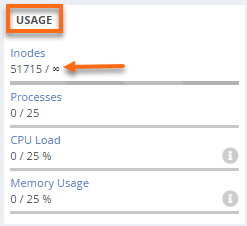
Both Shared and Cloud hosting customers can find their cPanel's inode count in the Usage section on the right-paw menu.
To locate your inode count in cPanel:
- Log in to cPanel.
- Navigate to the Usage section on the right-hand side. And then click on the Inodes link.
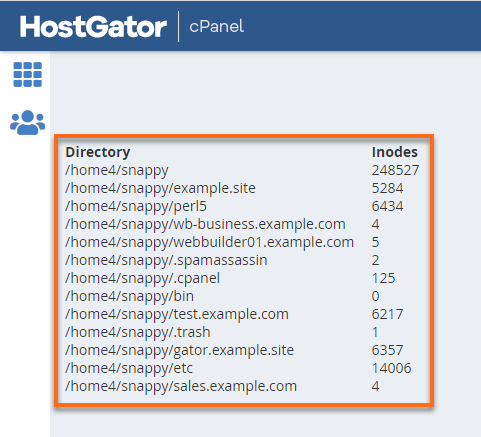
- The next folio will testify the full Inodes in your cPanel, and it is broken down per domain, addon domain, and subdomain.
Reseller and Optimized WordPress Hosting (OWP) Packages
Reseller and OWP users can phone call or bring together the live conversation, and nosotros will be glad to check the inode usage for your business relationship.
VPS Packages
Depending on whether you're a KVM or Legacy VPS/Dedi hosting customer, the instructions on viewing your Inode Usage vary.
Let us identify starting time if y'all are a KVM or Legacy VPS/Dedicated hosting customer.
KVM (Kernel-based Virtual Auto) VPS Hosting
- These are the VPS accounts purchased afterward April 13, 2021 (VPS) and Dedicated hosting purchased after Nov 2020.
- Your Plan ID begins with VH.
Legacy VPS Hosting
- These are the VPS accounts purchased before April 13, 2021 (VPS) and Dedicated hosting purchased before November 2020.
- Your Plan ID begins with VPS.
- Log in to the Client Portal.
- Navigate to the Hosting tab.

- Click on Manage underneath the primary domain of the hosting plan.
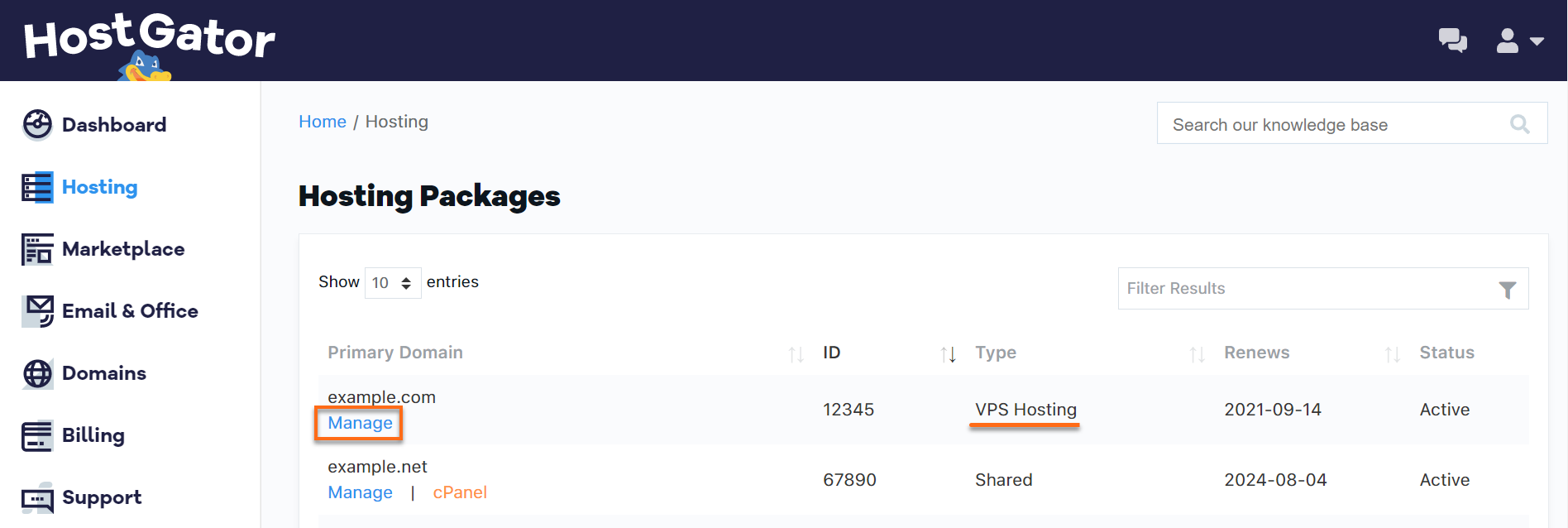
- On the acme-left side, you will find the Plan ID below your domain name.

KVM VPS Hosting
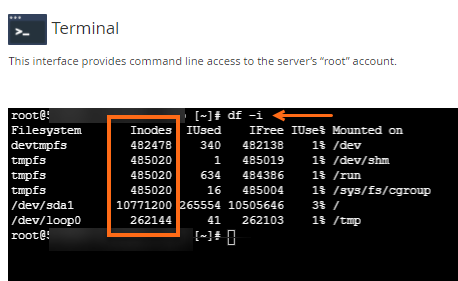
KVM VPS customers can view their Inode usage via the terminal.
- Log in to WHM.
- Search for Terminal using the search function on the left-hand side.
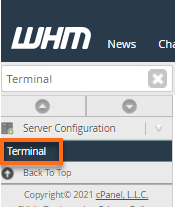
- In the terminal, run this command:
df -i. - And then, the result will show the Inodes in your server.
Legacy VPS
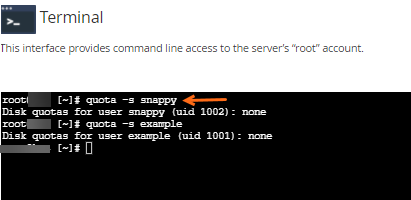
VPS customers tin view the current inode usage from the Virtuozzo Console, simply click on the Resources icon and check under the disk usage section. The limit is called "diskinodes" and will written report how many inodes are currently on your VPS business relationship. Yous can likewise cheque your Inodes usage via the Terminal. Here'southward how:
- Log in to WHM.
- Search for Last using the search part on the left-manus side.
- In the terminal run this command:
quota -s <cpanel username>. - Then, the result will bear witness the Inodes in your server.
All Accounts with SSH Admission
Shared and Cloud Hosting, VPS, and Dedicated hosting all have SSH by default. Using SSH, you can check the inodes of an business relationship by using the following control:
quota -southward <cpanel username> Users with root access may utilize the above control to check the inodes of any account on their server, and all other users will only be able to bank check their own username.
Y'all tin can view the specific folder'south inode count by using the control:
repeat "Detailed Inode usage for: $(pwd)" ; for d in `find -maxdepth 1 -type d |cut -d\/ -f2 |grep -15 . |sort`; do c=$(detect $d |wc -l) ; printf "$c\t\t- $d\n" ; done ; printf "Total: \t\t$(observe $(pwd) | wc -l)\north" This may look messy, however, the output shows a nicely formatted list of detailed inode count on your account:
TOS Inode violations can consist of the post-obit (notwithstanding non limited to):
- Continuously deleting and publishing and large numbers of files (i.eastward., x,000+)
- If the cPanel exceeds 200,000 inodes, please refer to section C. Unacceptable Resources Usage, Part B. Inodes of our Acceptable Employ Policy.
Source: https://www.hostgator.com/help/article/inode-usage
0 Response to "Hostgator Baby Plan Limits Video Upload Size"
Post a Comment